
What the Next Generation of Commercial Construction Platforms Will Look Like
Most commercial builders don't run their projects on one platform. They run them on five: a scheduling tool, a spreadsheet for cost, a document store for drawings, an email inbox for RFIs, and a folder full of PDFs nobody can find. Each does one job reasonably well, and none of them talk to each other. That fragmentation is the real cost centre in construction, and it's exactly what the next generation of commercial construction software is built to remove.
The shift underway is bigger than a new feature or a better dashboard. It's a change in what a construction management platform is. For the mid-tier commercial builders who make up the backbone of the Australian and New Zealand market, the platform they choose over the next few years will shape how many projects they can run, how thin their margins get, and whether their best people spend their days building or reconciling. Here's what that next generation will actually look like.
Why today's construction software holds builders back
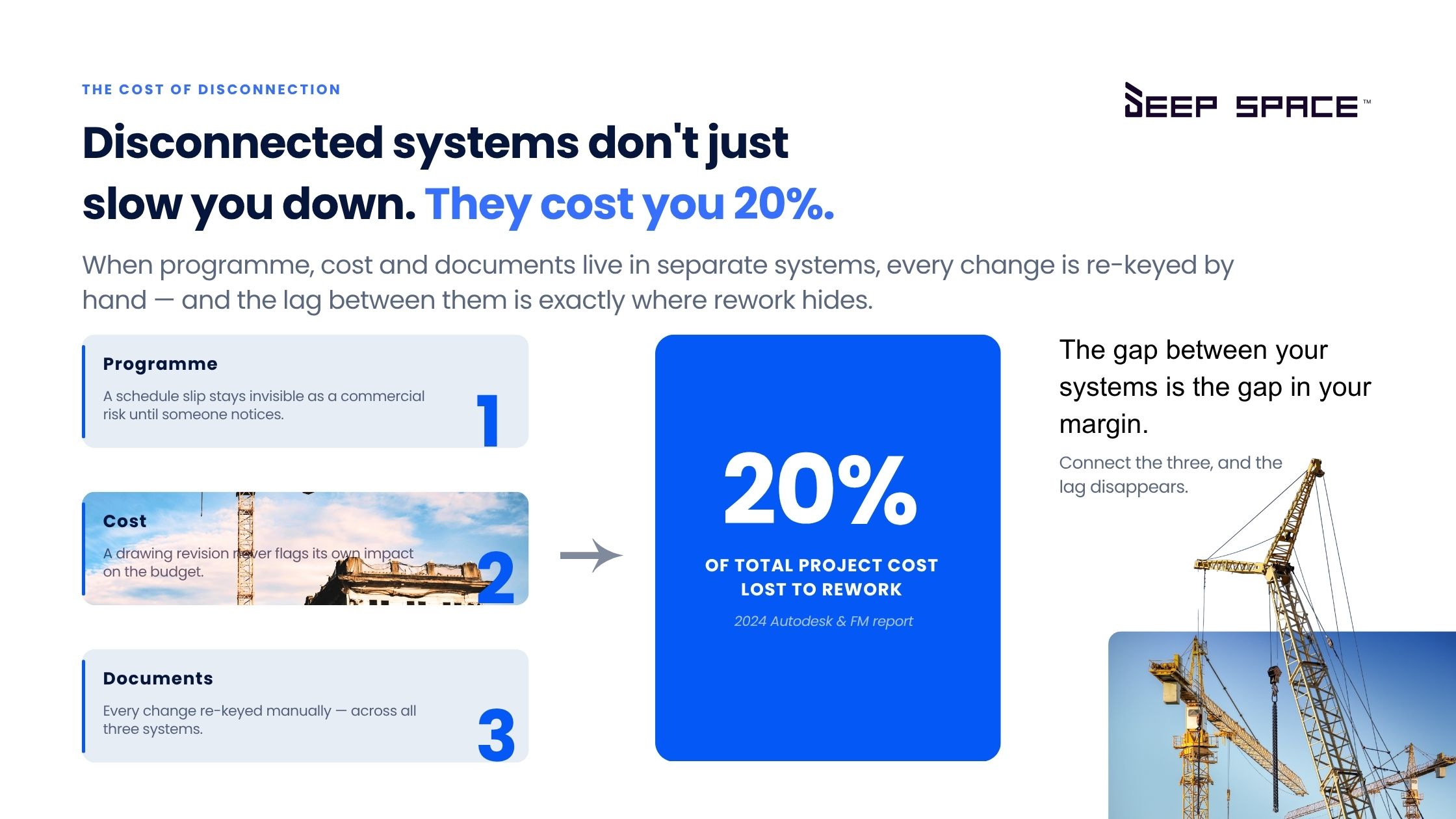
The problem isn't that current tools are bad. It's that they're disconnected, and disconnection is expensive.
When your programme lives in one system, your cost in another, and your documents in a third, every change has to be manually re-keyed across all of them. A drawing revision doesn't automatically flag its impact on the budget. A schedule slip doesn't surface as a commercial risk until someone notices. That lag is where rework hides, and rework can consume as much as 20 per cent of total project cost according to the 2024 Autodesk and FMI report.
The ANZ market feels this acutely because of how it's structured. Around 98.5 per cent of Australian construction firms have fewer than 20 employees, per CEDA's analysis of ABS data, and smaller firms consistently produce less revenue per worker, largely because they lack the systems and technology investment that Tier 1 contractors take for granted. Add a labour shortfall that Infrastructure Australia estimates at around 141,000 workers and rising toward 300,000 by mid-2027, and the maths is unforgiving: builders have to deliver more with less, and disconnected tools make that impossible.
This is the gap that next generation construction technology is closing.
The defining traits of the next generation
1. One connected data core, not a stack of point solutions
The single biggest change is architectural. Instead of stitching together separate apps, the next generation runs on one connected project record where programme, cost, documents, RFIs and delivery all share the same source of truth. Integrated construction management software means a change in one place updates everywhere it matters, automatically. No re-keying, no version confusion, no reconciling three systems at month's end. This is the foundation everything else depends on, because intelligence is only as good as the data it can see.
2. AI-native, not AI bolted on
Plenty of vendors have added a chatbot to a legacy product and called it innovation. The next generation is different: it treats AI as core infrastructure. A true AI construction platform reviews drawings the moment they're uploaded, cross-references them against the rest of the consultant package, flags scope gaps and clashes, and can draft the RFI for a human to send. The work that used to eat days of a QS's or PM's week happens continuously, in the background, with people staying firmly in control of the decisions.
3. Commercial and programme in real time
For most builders today, the commercial picture is always slightly out of date. Budgets, variations and forecasts get updated after decisions are already made. The next generation of construction project management software collapses that lag: cost-to-complete, claims and variations sit on live data, and the platform surfaces the commercial impact of a document change or a programme shift as it happens. Given that contract variations can affect up to 30 per cent of a project's scope, seeing the knock-on effect instantly rather than weeks later is the difference between managing a project and chasing it.
4. Built for the field, not just the office
A platform that only works at a desk is already behind. The next generation is mobile-first and built for how site teams actually work: capturing issues, checking the latest drawing, logging progress and raising an RFI from the field, with everything syncing back to the same connected record in real time. The office and the site stop working from different versions of the truth.
5. Designed for mid-tier builders, not scaled-down enterprise
Historically, sophisticated platforms were designed for Tier 1 contractors, then sold down-market as stripped-back versions that still carried enterprise complexity and enterprise rollout timelines. The next generation flips that. Today, the best commercial construction software Australia and New Zealand builders can adopt is built specifically for mid-tier commercial builders, with implementations measured in weeks rather than the eighteen-month deployments of the past. Capability that once required a large team and a Tier 1 budget becomes accessible to a lean operation, which is a genuine equaliser in a fragmented market.
What this means for ANZ commercial builders
The direction of travel is clear. A 2024 IFS report predicts that 90 per cent of construction companies will move to cloud-based technology within five years, and that around 30 per cent will deploy AI and automation within three. The builders who benefit most won't be the ones who wait for the technology to fully mature. They'll be the ones who consolidate onto a single connected platform now and build the habit on a live project.
A few things to weigh when assessing your options:
- Prioritise connection over features. A tool with one more feature but no integration will always lose to a platform where everything shares one record. Ask what actually talks to what.
- Check whether AI works inside your workflows. A genuine AI construction platform reviews your drawings and drafts your RFIs where you already work. A bolt-on chatbot in a side panel does not.
- Weigh time-to-value. If a rollout takes a year, it costs you a year. Favour platforms built for fast adoption by mid-tier teams.
- Make sure it works on site. If your field teams can't use it easily from a phone, the data will always be stale.
The bottom line
The next generation of commercial construction software isn't a better version of the tools you use today. It's a different shape entirely: one connected platform, AI built into the core, live commercial visibility, and a design made for mid-tier builders rather than Tier 1 giants. In a market squeezed by labour shortages and thin margins, that shift favours the operator who runs lean and moves early.
Deep Space is the construction management platform built for ANZ mid-tier commercial builders, bringing programme, cost, documents and delivery onto one connected record, with its AI layer KAI reviewing drawings, surfacing risks and drafting RFIs as your project runs. If you want to see what the next generation looks like on a live job rather than a slide, book a demo with the Deep Space team and bring a real project along.
Frequently asked questions
What is a commercial construction platform?
A commercial construction platform is software that manages a building project's programme, cost, documents, RFIs and site delivery in one connected system. Next-generation platforms replace separate point tools with a single source of truth, so a change in one area updates everywhere automatically.
What makes construction software "next generation"?
Next generation construction technology is defined by four traits: one connected data core instead of disconnected apps, AI built into the workflows rather than bolted on, real-time commercial and programme visibility, and a mobile-first design that works on site. For ANZ builders it also means being built for mid-tier firms, not scaled-down enterprise.
How is AI used in construction management software?
An AI construction platform reviews drawings on upload, cross-references them against the consultant package, flags scope gaps and clashes, and can draft RFIs for a human to review. This shifts problem-solving into preconstruction, where fixing issues is far cheaper than reworking them on site.
What should mid-tier commercial builders look for in construction software in Australia?
Mid-tier commercial builders in Australia should prioritise integrated construction management software that connects programme, cost and documents on one record, uses AI inside everyday workflows, works on site from a phone, and can be rolled out in weeks rather than months.
Why does integration matter more than features?
Because disconnected tools force manual re-keying, which creates lag, version errors and rework. Integrated construction project management software removes that friction by keeping every part of the project on the same live data, so decisions are made on current numbers.