
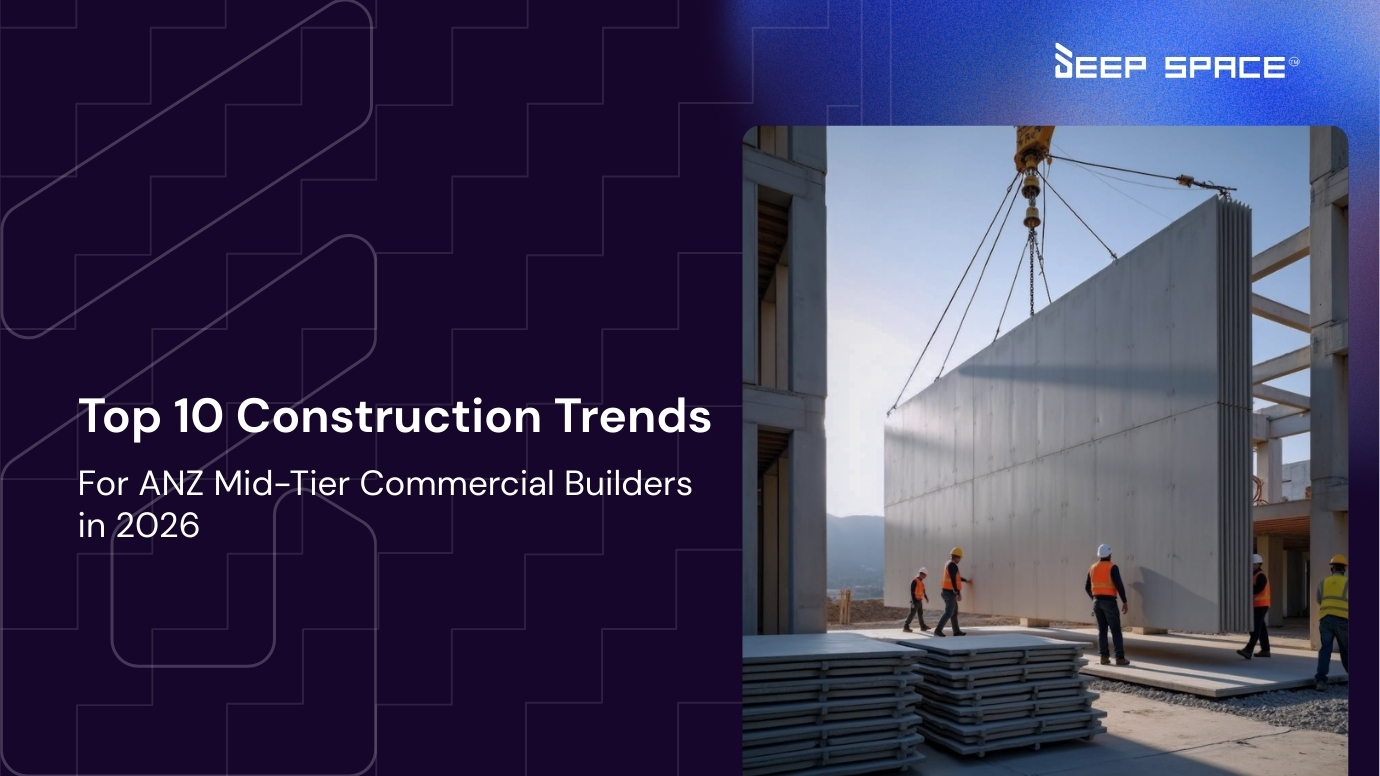
Top 10 Construction Trends for ANZ Mid-Tier Commercial Builders in 2026
The Australian and New Zealand construction market is not short on activity. What it is short on is clarity.
Mid tier commercial builders sit in a tough middle ground. Projects are complex enough to need real systems, but not big enough to survive enterprise software bloat, delays, or disconnected teams. In 2026, the builders who win will not be the ones adding more tools. They will be the ones removing friction.
These construction trends are already shaping how ANZ commercial projects are planned, delivered, and protected.
1. Project visibility is becoming a commercial risk, not an ops problem
One of the biggest construction trends in Australia right now is the shift from reactive reporting to real time visibility.
Most project delays do not start as disasters. They start as small slips that no one notices early enough. By the time leadership asks why a project is late, the system can tell them what moved, but not why it moved.
Mid tier builders are now under pressure to explain delays clearly to clients, financiers, and internal teams. Static reports and siloed dashboards are no longer enough.
Why this matters
- Construction project delays in Australia are increasingly linked to poor visibility, not poor planning
- Claims, variations, and disputes all start with missing context
- Leadership wants answers, not screenshots
Real time construction reporting is becoming a baseline expectation, not a nice to have.
2. Cost overruns are being driven by fragmented data, not bad estimates
Construction cost overruns across Australia and New Zealand are rarely caused by one bad decision. They are caused by ten small ones that never connect.
Cost data lives in one place. Site updates live in another. RFIs, variations, and safety issues live somewhere else entirely. When teams cannot see how these signals interact, costs drift quietly.
This is why construction data silos are now being called out as a structural problem.
Trend shift
Builders are moving away from spreadsheets and disconnected tools toward connected construction platforms that link cost, progress, and risk in one view.
3. AI in construction is moving from hype to background utility
AI in construction Australia has entered a more practical phase.
Project teams do not want another dashboard. They want fewer things to look at. The real value of construction AI is not prediction for prediction’s sake. It is quiet assistance.
Construction AI for project managers is now being used to:
- Flag delays before they become visible in reports
- Surface risks hidden across safety, cost, and schedule
- Suggest actions based on live project data
The key trend is that AI is becoming invisible. It works in the background and steps in only when something needs attention.
4. Field teams expect systems that work the way sites actually run
Construction field apps in Australia have matured, but expectations have changed.
Site teams do not want to log into five tools. They want to capture updates once and move on with their day. Mid tier commercial builders are prioritising tools that respect site reality.
What is changing
- Fewer forms, more context
- Faster capture of progress, issues, and safety items
- Automatic flow of site data into reporting and decision making
Digital construction reporting now starts on site, not in head office.
| Also Read: Role of Real-Time Scheduling in Large-Scale Construction Projects |
5. Safety and compliance are shifting from paperwork to risk prevention
Construction safety compliance software in ANZ is no longer judged by how well it stores documents. It is judged by how well it prevents incidents.
Builders are under growing pressure to show that safety systems actively reduce risk, not just record it.
Key trend
Safety data is being treated as an early warning signal. When safety issues, permits, or SWMS approvals stall, they often point to broader delivery risk.
This is why construction risk management software is becoming central to project control, not just HSEQ teams.
6. Connected platforms are replacing tool stacks
One of the clearest construction management trends in Australia is tool consolidation.
Mid sized builders are realising that more software does not equal more control. It often creates blind spots.
Connected construction platforms are replacing stacks of:
- Project management tools
- Safety systems
- Reporting spreadsheets
- Standalone field apps
The goal is not fewer features. There are fewer gaps.
7. Reporting is shifting from historical to decision ready
Construction reporting challenges are forcing a rethink. Most reports still explain what already happened. In 2026, the expectation is that reports should help teams decide what to do next.
Modern reporting focuses on
- Why something changed
- What risk it creates
- What action is required
This is where real time site visibility construction tools are pulling ahead of legacy systems.
8. Integration is no longer optional
Construction software integration has moved from “nice to have” to mandatory.
Builders use accounting systems, scheduling tools, and procurement platforms that cannot be replaced overnight. The trend is toward construction management platforms that integrate cleanly instead of forcing rip and replace decisions.
Disconnected systems are now seen as a risk multiplier.
9. Mid tier builders are rejecting enterprise complexity
One of the quietest but most important trends is buyer pushback.
Many ANZ builders have tried enterprise construction management software and stepped away. The feedback is consistent.
- Too complex
- Too slow to adopt
- Too heavy for how mid sized teams actually work
This is why searches for Procore alternatives in Australia continue to grow. Builders want modern construction management software without the overhead.
10. The construction management platform is becoming the operating system
The final trend ties everything together.
Construction management software in Australia is no longer evaluated feature by feature. It is evaluated as an operating system for delivery.
Builders are asking:
- Does this platform give me a single source of truth
- Can my PMs explain what is happening without manual work
- Does leadership get clarity without chasing updates
Platforms that answer yes are becoming central to how commercial builders operate.
What this means for ANZ commercial builders
These construction trends in Australia and New Zealand point to one thing. Control now comes from connection, not control through process.
Mid tier commercial builders need systems that help them see early, act faster, and explain clearly. This is exactly why modern construction management platforms are being designed differently from legacy tools.
Solutions like Deep Space are built around this shift. Not more dashboards. No more noise. Just clear signals across cost, time, safety, and delivery, connected in one place.