
The Early Warning Signs of Construction Cost Blowouts
A construction cost blowout almost never happens overnight. It builds quietly, one unpriced variation and one stale spreadsheet at a time, until the gap between what you budgeted and what you're spending is too big to close. By the time it shows up in a monthly report, the damage is already done and the margin is already gone.
That's the frustrating truth about construction cost overruns: the signals are almost always there early, weeks before the number turns red. The builders who protect their margins aren't the ones who react fastest to a blowout. They're the ones who learn to read the warning signs before the blowout happens at all. For mid-tier commercial builders across Australia and New Zealand, where a single bad job can wipe out the profit from three good ones, that early read is everything.
Here are the warning signs worth watching, and what they're really telling you.
Cost blowouts are rarely a surprise
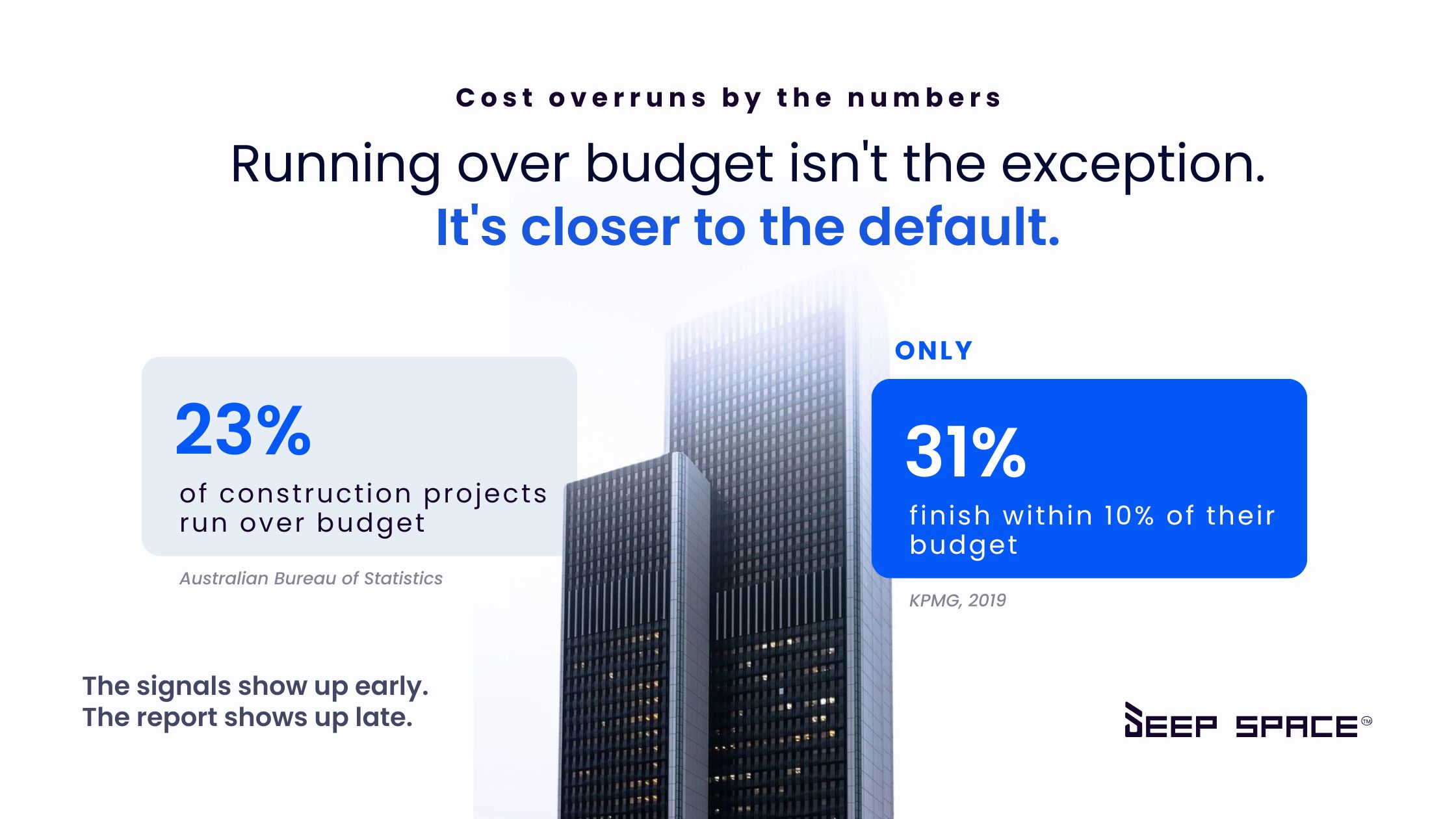
The data makes the point plainly. According to figures drawn from the Australian Bureau of Statistics, around 23 per cent of construction projects experience cost overruns, and a 2019 KPMG study found only about 31 per cent of projects landed within 10 per cent of their budget over the prior three years. In other words, running over budget isn't the exception in this industry. It's closer to the default.
The reasons cluster around a small number of recurring causes: scope that expands without being priced, drawing gaps that surface as expensive rework, variations that go untracked, and cost data that's always a few weeks behind reality. None of these arrive without warning. Each one leaves a trail. The problem is that on most projects, nobody is watching the trail in real time, because the information is scattered across a spreadsheet, an inbox and a scheduling tool that don't talk to each other.
Strong construction cost management starts with recognizing the signals early. Here are the six that matter most.
The six early warning signs
1. Your budget lives in a spreadsheet that's always out of date
If your single source of financial truth is a spreadsheet updated once a fortnight, you are always making decisions on old numbers. By the time the budget register reflects a committed cost, the PM has already approved the next one. This lag is the single most common precursor to construction budget overruns, because you can't control what you can't see in time. If answering "what's our real cost-to-complete today?" takes more than a few minutes, that's a warning sign in itself.
2. Variations pile up without being tracked or priced
Variations are where margin quietly leaks. A verbal instruction here, a minor scope change there, none of it formally captured or priced, and three months later you're carrying tens of thousands in unrecovered work. Contract variations can affect up to 30 per cent of a project's scope, and industry analysis suggests every 1 per cent of unmanaged scope creep can add roughly 1.6 per cent to final cost. If your variation register is incomplete or lags the work on site, you have a blowout forming.
3. Drawing gaps and RFIs keep surfacing on site
When trades hit a conflict between drawings and stop to raise an RFI, work pauses and rework risk climbs. A steady stream of clarifications and clashes appearing once construction is underway is a strong signal that scope gaps slipped through in preconstruction, and those gaps almost always convert into cost. The earlier a coordination issue is caught, the cheaper it is to fix. Catching it on site is the expensive option.
4. Your forecast and your actuals are drifting apart
Every healthy project has a forecast cost-to-complete that tracks reasonably close to actual spend. When the two start to diverge and the gap widens week on week, that drift is the clearest early indicator of a blowout in motion. The danger is that on a lagging system, you often can't see the drift until it's a chasm. Effective construction cost control depends on watching that gap continuously, not discovering it at month's end.
5. Nobody can answer "where are we, right now?"
Ask your team for the current commercial position and time how long it takes. If the answer requires someone to reconcile three systems, chase a subcontractor claim and update a spreadsheet before they can respond, your cost data is structurally too slow to manage risk. Cost overruns in construction Australia and New Zealand thrive in exactly this gap, the days or weeks between something happening and anyone being able to see it.
6. Rework hours keep eating time nobody planned for
Rework is both a cost and a symptom. It can consume as much as 20 per cent of total project cost according to the 2024 Autodesk and FMI report, and a rising rework rate usually points back upstream to unclear scope, poor coordination or late information. If your team is repeatedly redoing work that was signed off, the budget is being eaten from a source your cost report may not even be capturing.
From lagging reports to live cost control
The common thread across all six signs is time. Every one of them is a gap between something happening on the project and someone being able to see it in the numbers. Close that gap and most blowouts become manageable while they're still small.
That's the shift the best commercial builders are making: from lagging monthly reports to live cost control. Instead of a spreadsheet reconciled after the fact, cost-to-complete, variations and claims sit on live data that updates as the project moves. Modern construction cost tracking software goes a step further, using AI to surface the commercial impact of a document change or a variation the moment it lands, so the warning sign reaches a human while there's still time to act on it.
For mid-tier commercial builders, this is the difference between managing margin and mourning it. The tools that used to require a Tier 1 budget are now built for lean teams, and the payback is direct: every blowout caught early is margin kept.
The bottom line
Construction cost blowouts don't come out of nowhere. They announce themselves through stale budgets, untracked variations, late RFIs, drifting forecasts, slow answers and creeping rework. The builders who stay profitable are simply the ones who see those signals in time, and seeing them in time depends entirely on how fast and how connected your cost data is.
Deep Space is the construction management platform built for ANZ mid-tier commercial builders, bringing programme, cost, documents and delivery onto one connected record, with real-time commercial visibility and an AI layer, KAI, that reviews drawings and flags risks before they become variations. If you want to catch cost blowouts while they're still small, book a demo with the Deep Space team and bring a live project along.
Frequently asked questions
What are the early warning signs of a construction cost blowout?
The main early warning signs are a budget that updates too slowly to guide decisions, variations that go untracked or unpriced, frequent RFIs and drawing gaps surfacing on site, a widening gap between forecast and actual spend, no single up-to-date view of the commercial position, and rising rework hours. Each signals a cost overrun forming before it appears in a report.
What causes construction cost overruns?
Construction cost overruns are mostly caused by unpriced scope creep, poor early planning and estimating, drawing and coordination gaps that trigger rework, untracked variations, and material price escalation. Around 23 per cent of construction projects run over budget, and the causes are usually visible early rather than sudden.
How can builders prevent cost blowouts?
Builders prevent cost blowouts by shifting from lagging monthly reports to real-time construction cost control: keeping cost-to-complete, variations and claims on live data, tracking variations as they happen, and catching drawing gaps in preconstruction. Live construction cost tracking software surfaces the commercial impact of changes early, while issues are still small and cheap to fix.
What is construction cost management?
Construction cost management is tracking a project's costs against its budget from estimate to completion. AI-powered commercial construction management software in Australia now automates this by comparing forecast against actual spend in real time, catching overruns before they reach a report.
How common are cost overruns in construction in Australia?
Cost overruns in construction in Australia are common. Figures based on ABS data indicate around 23 per cent of projects run over budget, and a KPMG study found only about 31 per cent of projects finished within 10 per cent of budget, meaning most projects miss their original cost target to some degree.