
AI Construction Cost Forecasting: How Mid-Tier Builders Get Live Cost-to-Complete Without a Cost Engineer on Every Project
For mid-tier commercial builders running $20M to $100M projects across Australia and New Zealand, the cost forecast is rarely the problem at tender. The problem starts in week six. Variations have begun, the programme has shifted, two trades are running ahead of plan and one is two weeks behind, and the cost report still reflects last month's reality. By the time the commercial team reconciles the numbers, the project manager has already committed to decisions based on figures that no longer hold. This is the gap AI construction cost forecasting is built to close.
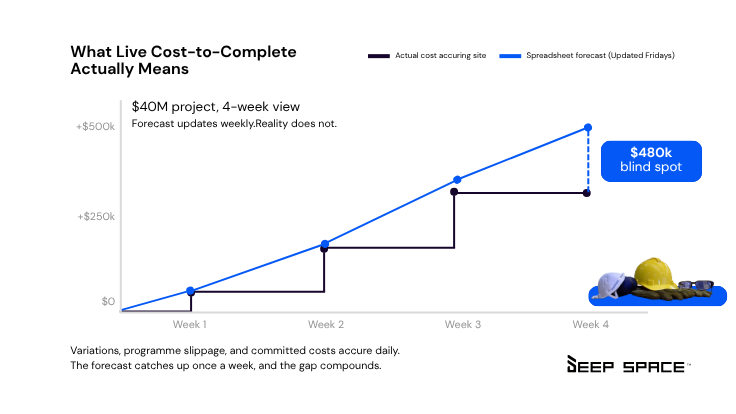
What Live Cost-to-Complete Actually Means
Cost-to-complete is the running answer to one question: from this moment, how much more will it cost to finish the project? It is the difference between a healthy margin and a write-down at the end.
KPMG analysis cited across the industry has shown only 31% of construction projects come within 10% of budget, and the Grattan Institute estimates around 65% of Australian projects experience cost overrun, averaging between 9% and 20%.
Most of that drift is not caused by bad estimating. It is caused by stale data. Spreadsheets get updated weekly at best, and on a $40M project, a week of unrecorded variations, programme slippage, and committed costs is enough to swing the forecast by hundreds of thousands.
Live cost tracking construction means the budget register, commitments, actuals, and forecast move in step with the project, not a fortnight behind it.
Why Mid-Tier Builders Cannot Solve This With Headcount
Tier 1 contractors solve cost forecasting with people. A dedicated cost engineer or commercial assistant on every site, full-time, doing the data entry that keeps the forecast current. At a fully-loaded cost north of $130,000 per year per resource, on a portfolio of eight to twelve concurrent projects, that is a line item mid-tier builders cannot carry without breaking margin.
The alternative most mid-tier builders default to is Excel and Jobpac, with a commercial manager covering three or four projects at once. The forecast becomes whatever the QS had time to update last Friday. That model breaks at scale, and it breaks fastest on the projects that matter most.
What AI Construction Cost Forecasting Replaces
AI cost forecasting construction tools work by ingesting data from the systems already running the project, the drawing register, the variation register, the programme, the procurement schedule, signed subcontracts, and the accounting integration, and continuously rebuilding the forecast from that live data. No one is typing numbers from one system into another. The forecast updates as the project moves.
Construction cost forecasting software Australia teams are now adopting does three things a spreadsheet cannot:
It connects programme to cost. When a trade slips two weeks, the impact on prelims, on retentions, on the final account date, surfaces immediately rather than at month-end review. It surfaces commercial risk from documents. When a new revision drops into the drawing register, the system reads the changes and flags scope shifts that will become variations.
It maintains a single source of truth. The cost report your owner-director sees on Tuesday is the same number your PM sees on site Tuesday morning.
How Deep Space Handles Cost-to-Complete With KAI
Deep Space was built for exactly this segment, mid-tier ANZ commercial builders running portfolios from $100k jobs through to $100M+ projects, and the platform's commercial module is wired into the rest of the project rather than sitting beside it.
The budget register tracks committed cost, actuals, and cost-to-complete on a live basis. Variations move from instruction through to claim inside the same record. Payment schedules, retentions, and progress claims are tracked against the same data. Xero integration handles invoice reconciliation without re-keying.
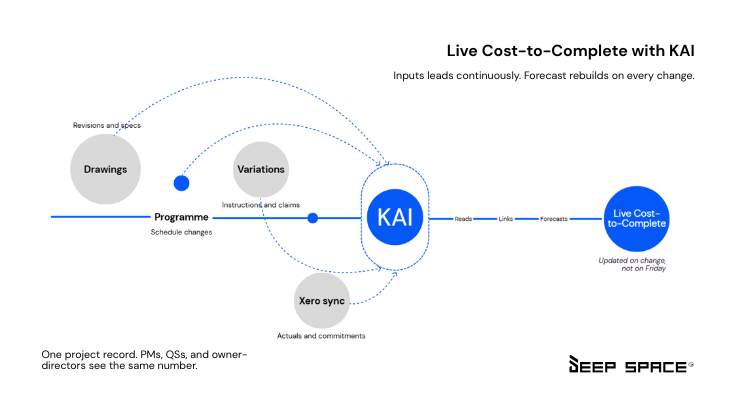
KAI, the construction intelligence layer embedded across every Deep Space module, is what turns this from real-time cost reporting into real cost forecasting. KAI reviews drawings on upload and flags scope gaps before they become RFIs. It analyses consultant reports for commercial risk. When the programme changes, KAI surfaces the cost impact rather than waiting for the QS to model it manually. One commercial director put it plainly after running partial document sets through the system: KAI picked up scope gaps and risk items that the team had missed in manual review, and the outputs changed how they reviewed projects.
The value for mid-tier builders is not that AI replaces the commercial manager. It is that one commercial manager can now run the same forecast quality across four projects that previously required dedicated cost engineering on each.
What Changes in Practice
On a $30M fitout running through Deep Space, the workflow looks different from week one. Drawing revisions are read on upload, suggested RFIs are drafted automatically, the variation register reflects them in commercial impact within hours rather than weeks. The programme and the budget share the same project record, so when the lookahead shifts, the cost-to-complete shifts with it. The owner-director's Monday morning report is built from live data, not last week's.
For builders evaluating cost forecasting software for commercial builders ANZ, the comparison is no longer feature against feature. It is whether the tool sits where the work happens, or whether it is another system the team has to update at the end of the day. Construction cost overrun prevention software only works if the prevention happens before the cost is committed, not after.
Where to Start
Most mid-tier builders do not need to rip out their cost stack to get live cost-to-complete. They need one connected platform that handles commercial, programme, documents, and delivery in the same record, with AI surfacing risk before it shows up on the variation register.
That is the case for moving from a passive system of records to an active intelligence layer. The forecast is only as good as the data feeding it, and the data is only useful if it arrives in time to change a decision.Deep Space typically goes live on a real project in three weeks rather than the year-long enterprise rollout that puts most platforms out of reach for mid-tier teams. Walk through how live cost-to-complete looks on a project structured like yours, in 30 minutes, no commitment required.
Frequently Asked Questions
1. What is AI construction cost forecasting?
AI construction cost forecasting uses connected project data to maintain live, accurate cost-to-complete figures on commercial projects. Rather than relying on periodic manual updates, it adjusts forecasts automatically as variations, programme changes, and subcontractor claims are processed through the platform.
How does cost-to-complete construction software work?
It connects committed costs, variations, and programme data in a single system. When any input changes, the forecast updates automatically. Platforms that connect cost to programme can flag the commercial impact of a schedule shift without requiring manual reconciliation.
Can mid-tier builders use AI cost forecasting without a dedicated cost engineer on every project?
Yes. AI cost forecasting extends the capacity of the commercial team already in place. A QS supported by a connected platform can maintain live cost visibility across multiple concurrent projects without building and maintaining separate spreadsheet models for each one.
What is the best AI cost forecasting software for ANZ commercial builders?
The right tool for ANZ mid-tier commercial builders running $20M to $100M projects is one that handles the full project lifecycle, not just cost. Standalone estimating tools like CostX, Cordell, or Buildxact are built for residential or pre-tender work, while enterprise platforms like Procore are priced and structured for Tier 1 contractors. Mid-tier builders typically need a platform like Deep Space that connects commercial, programme, documents, and delivery in one record, with AI embedded across every workflow rather than bolted on as a separate feature.
What is the difference between construction cost forecasting and cost reporting?
Cost reporting describes where a project has been financially. Cost forecasting shows where it is going. A report is produced periodically and reflects historical data. A live forecast updates continuously as project conditions change and gives commercial managers the visibility to act before costs are committed.
Is construction budget forecasting tools Australia-specific software available for ANZ builders?
Yes. Platforms built specifically for the ANZ commercial construction market offer cost forecasting tools designed around local contract structures, ANZ variation management workflows, and subcontractor payment processes. These differ meaningfully from US-built enterprise platforms that require significant configuration to reflect how commercial projects are actually run in Australia and New Zealand.