
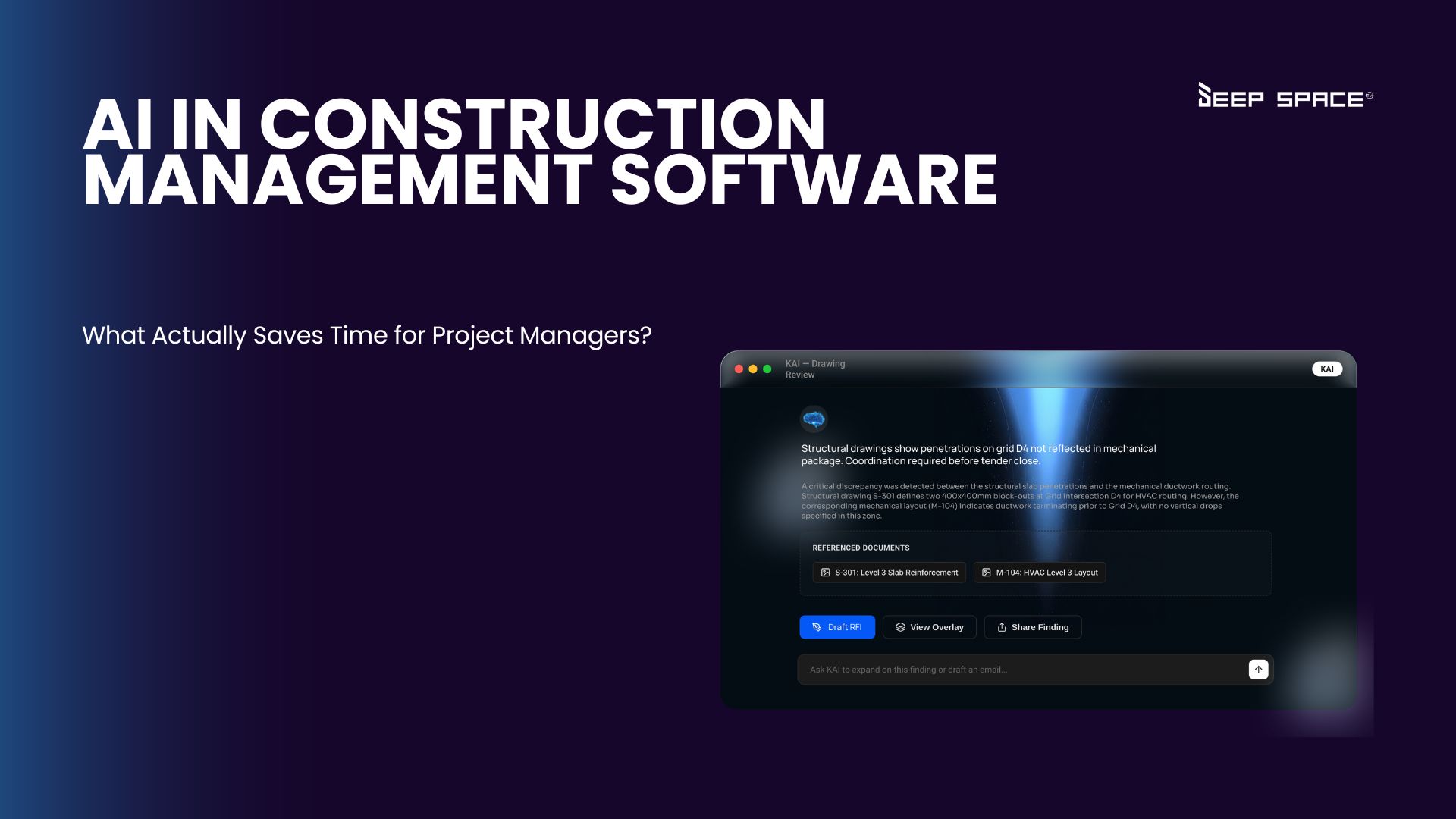
AI in Construction Management Software: What Actually Saves Time for Project Managers?
Most construction software promises visibility. But visibility is not the problem. If you’re a project manager running mid-sized commercial builds across Australia or New Zealand, you already have visibility. What you don’t have is time.
Chasing context consumes time. Jumping between drawings, emails, RFIs, and program updates takes time. Rechecking items you've previously reviewed can be a time-consuming task. We are trying to connect site reality with commercial impact. That’s where most tools fall short. They capture information. They don’t reduce the effort required to manage it.
This is why AI construction management software in Australia is becoming relevant. Not because it sounds advanced, but because it has the potential to remove the invisible workload that sits inside every project. The question is not whether AI exists in your tool. The question is whether it actually reduces work.
The Real Reason Projects Slow Down
Construction delays usually result from multiple small issues. They build up from small inefficiencies that compound across weeks.
- A missed detail in a drawing leads to an RFI.
- An RFI delays a decision.
- The delay affects the program's sequencing.
- Then cost implications follow.
Most teams are reacting to problems after they appear. Even with existing construction project management software AI, a lot of the process still depends on manual effort. Someone has to connect the dots. Someone has to interpret the impact. That “someone” is usually the project manager.
What AI Needs to Do to Be Useful
For AI to actually matter on-site and in the office, it cannot sit outside the workflow. It has to operate inside the decisions PMs are already making. Real AI for project managers works when it reduces the thinking and coordination load, not when it adds another interface to manage. This means AI should:
- Understand drawings and project data without manual tagging
- Link issues directly to programme and commercial impact
- Surface risks early, not after they escalate
- Reduce repetitive communication loops
If the AI requires constant input, setup, or interpretation, it is not saving time. It is just shifting effort.
How AI Helps Construction Project Managers Save Time
The biggest shift is not automation. It is context awareness. In platforms like Deep Space, AI is not positioned as a feature you open separately. It acts as an intelligence layer across the workflows PMs already use. This changes how time is spent.
Instead of reviewing drawings in isolation, AI reads and interprets them alongside project data. Instead of writing RFIs from scratch, context is already connected. Instead of manually tracking how a site issue impacts costs or programs, those relationships are already visible.
Here’s where the actual time savings happen:
- Drawing reviews move from manual scanning to AI-assisted risk identification
- RFIs and correspondence start with structured context, not blank pages
- Site updates are translated into commercial and programme implications faster
- Information does not need to be reassembled across tools
This is what people mean when they ask how AI helps construction project managers save time. It removes the repeated effort of connecting information.
Why Most AI Tools Still Don’t Deliver
There is a reason many builders are still sceptical. Many tools introduce AI as an add-on. A chatbot. A reporting assistant. A system that operates independently. That doesn’t change how work gets done. Project managers don’t need another place to go. They need less work inside the tools they already use. Often, “AI construction management software in Australia” still behaves like traditional software with a smarter interface. The underlying workflows remain the same. Which means:
- You still review drawings manually
- You still write RFIs from scratch
- You still piece together project context
The workload stays. Only the UI changes.
The Shift: From System of Record to System of Work
This is where Deep Space is taking a different approach. Most construction platforms act as systems of record. You log information after the work is done. Deep Space is built as a system where the work actually happens, with AI embedded into that process.
KAI, the AI agent, operates across document control, commercial management, program delivery, and HSEQ. It reads drawings, understands project context, and surfaces insights directly where decisions are being made. That means less switching. Less repetition. Less manual interpretation. And more importantly, fewer missed connections between what is happening on-site and what it means for the project.
What This Means for Mid-Tier Builders
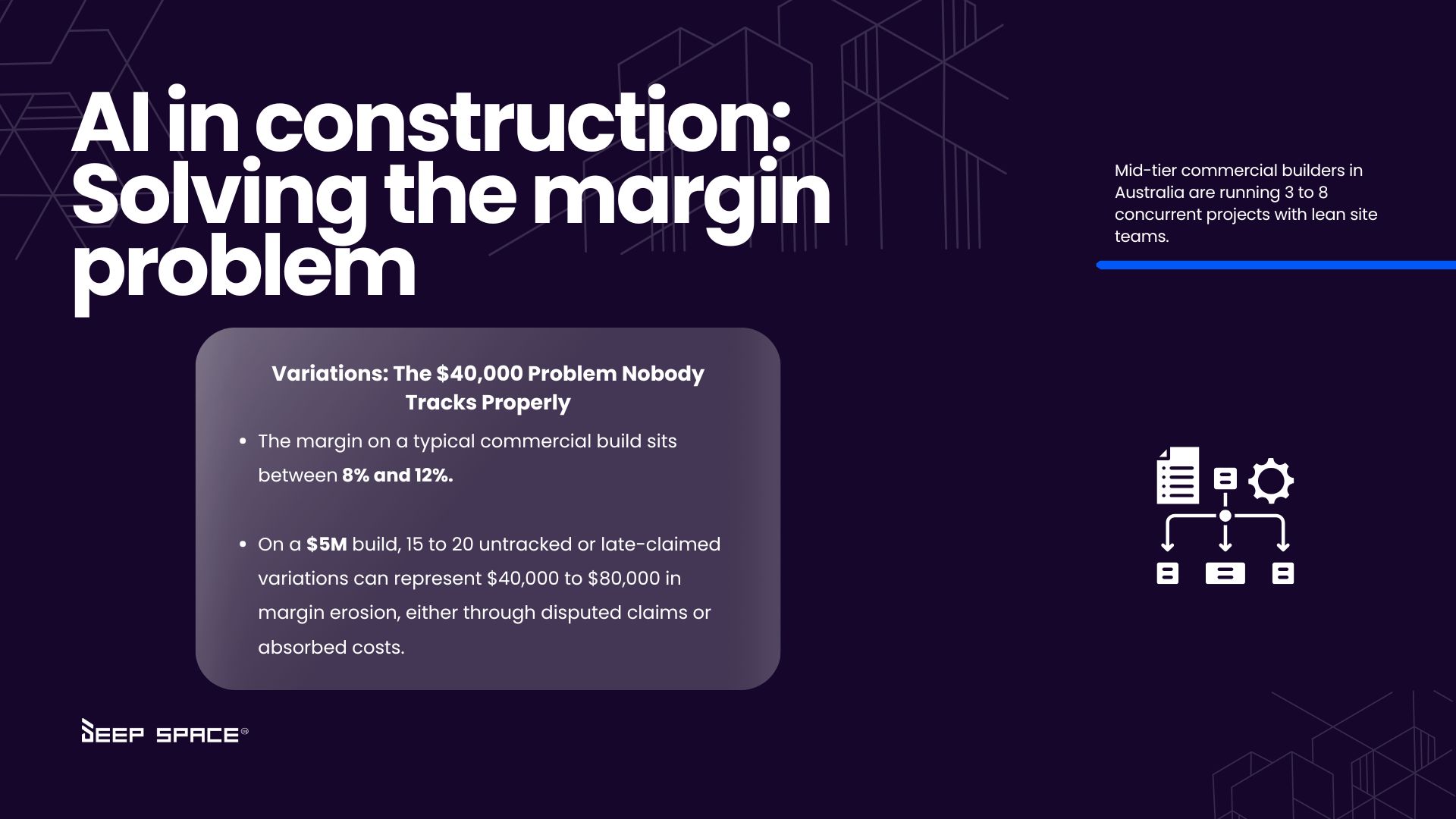
For mid-tier commercial builders in ANZ, the pressure is not just about delivering projects. It is about doing it with tighter teams, smaller margins, and increasing complexity. You don’t luxuriate in large admin layers or extended timelines.
Saving even a few hours a week per project manager compounds quickly across multiple projects.
AI becomes valuable when it:
- Reduces coordination overhead across teams
- Helps PMs make faster, more confident decisions
- Prevents issues before they escalate into delays
- Keeps projects moving without constant manual intervention
That is the difference between software that tracks work and software that actually helps run it.
Final Thought
AI in construction is not about replacing project managers. It is about removing the invisible work that slows them down. If your current system still requires you to constantly chase context, connect information, and rework the same tasks, then it is not solving the real problem. The next generation of construction project management software will not win simply because it looks better. It will win because it gives project managers their time back.
FAQs
What is AI construction management software in Australia?
AI construction management software in Australia refers to platforms that use artificial intelligence to assist with project workflows, such as drawing analysis, risk detection, RFIs, and program coordination. The goal is to reduce manual effort and improve decision-making speed for project managers.
How does AI help construction project managers save time?
AI helps construction project managers save time by reducing repetitive tasks like reviewing drawings, writing RFIs, and connecting project data. It provides context-aware insights that allow faster decisions without manually piecing information together.
Is AI for project managers replacing manual workflows?
AI for project managers is not replacing workflows but improving them. It reduces the effort required to manage tasks, rather than eliminating the role of the project manager.
What should builders look for in construction project management software AI?
Builders should look for AI that is embedded within workflows, understands project context, and reduces manual coordination. Tools that require heavy setup or operate separately from daily workflows often do not deliver real-time savings.
Why is AI important for mid-tier commercial builders in ANZ?
Mid-tier builders operate with lean teams and tight margins. AI helps by improving efficiency, reducing delays, and allowing project managers to handle multiple projects without increasing workload.