
The Rise of AI Construction Intelligence: What Changes Over the Next Five Years
Construction has spent the better part of two decades watching other industries pull ahead. In Australia, labour productivity in construction grew by roughly 17% over the 29 years to 2023/24, while the broader market sector grew 64% over the same period, according to CEDA's analysis of ABS data. The tools changed. The methods largely didn't.
That gap is about to close, and the reason is a shift in what construction software actually does. For twenty years, platforms have been passive systems of record: places teams go after the work happens, to file documents and generate reports. The next five years belong to something different. AI in construction that works inside the project as it runs, surfacing risk before it becomes rework. For mid-tier commercial builders across Australia and New Zealand, this is the most consequential change to how projects are managed since the move from paper to the cloud.
Here's what that shift looks like, and why the timing matters now.
Why the timing matters now for ANZ builders
Three pressures are converging on the ANZ market at once, and together they make the case for AI construction intelligence hard to ignore.
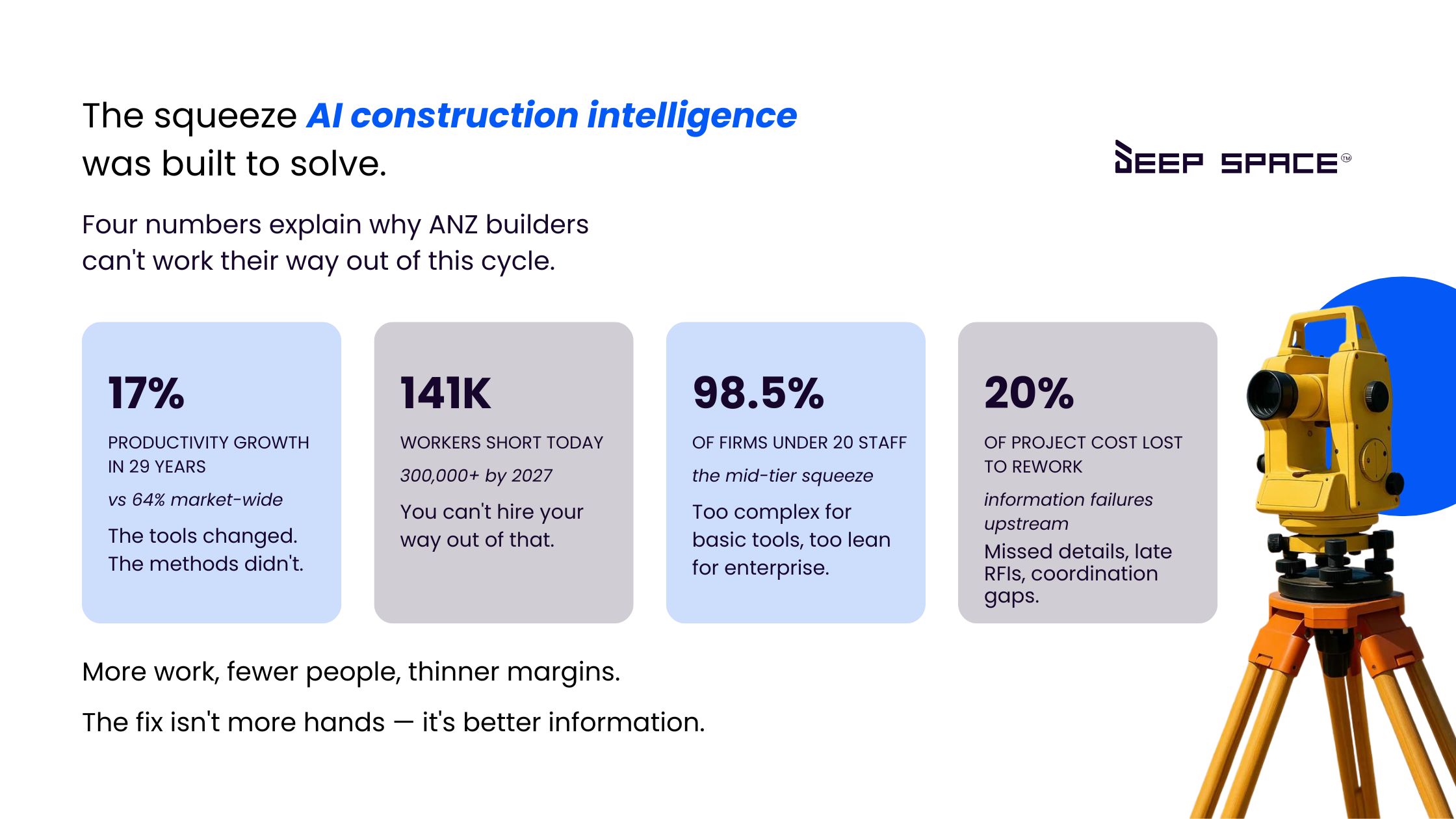
The first is labour. Infrastructure Australia estimates the industry is short around 141,000 workers needed to deliver the public pipeline alone, with that shortfall projected to climb past 300,000 by mid-2027 as energy and infrastructure projects ramp up. You cannot hire your way out of that. The only lever left is doing more with the teams you already have.
The second is fragmentation. About 98.5 per cent of Australian construction firms have fewer than 20 employees, and smaller firms consistently produce less revenue per worker than larger ones, largely because they can't access the scale, systems and technology investment that bigger contractors take for granted. Mid-tier commercial builders sit right in the squeeze: too complex for basic tools, too lean to absorb a year-long enterprise rollout.
The third is margin. Rework alone can consume as much as 20% of total project cost according to the 2024 Autodesk and FMI report, and most of it traces back to the same root causes: missed details in drawings, late RFI responses, and coordination gaps between trades. These aren't execution failures on site. They're information failures upstream, and they're exactly the kind of problem AI is now good at catching.
Put those three together and the picture is clear: builders need to manage more work, with fewer people, on thinner margins. That is the problem AI construction intelligence is built to solve.
From system of record to system of intelligence
The defining change of the next five years isn't that AI gets added to construction software. It's that intelligence gets built into the workflows teams already run, not bolted on as a separate tool you open when you remember to.
The distinction matters. A chatbot pinned to the corner of a dashboard is a novelty. AI that reads every drawing on upload, cross-references it against the rest of the consultant package, and flags a coordination clash before anyone raises an RFI is a genuine change in how projects are run. The first makes for a good demo. The second changes your risk profile.
This is the direction the market is moving, and it reframes the role of the platform entirely. Instead of a filing cabinet you update after decisions are made, the platform becomes the place where the analysis happens, where the review, coordination and commercial checks that used to eat days of a Quantity Surveyor's (QS) or Project Manager's (PM) week are handled continuously, in the background. The human stays in control. The AI handles the grind.
What changes over the next five years
1. Drawing and document review becomes proactive
Today, reviewing a consultant package is a manual slog. Your QSs and PMs comb through drawings looking for scope gaps and clashes, and plenty still slip through, surfacing later as RFIs or variations once trades are already on site. On a typical commercial project there are roughly 10 RFIs per $1 million of value, each taking around 9.7 days to resolve, and studies suggest almost 22 per cent never get a formal response at all. Every one of those is a potential schedule stall.
Over the next five years, AI drawing review flips this. Documents get analysed automatically on upload, scope gaps and coordination issues get flagged early, and the system can even draft the RFI for a human to review and send. Deep Space's KAI already works this way, reviewing drawings and specs as they land and surfacing risks across consultant packages before they reach the field. Catching a clash in preconstruction instead of during the build is the single highest-leverage thing AI does for a builder's margin.
2. Commercial visibility moves from lagging to live
For most builders, commercial data lives in spreadsheets that are updated after decisions are already made. By the time the budget register, variations and forecasts are current, the PM has already committed to something based on stale numbers.
The next generation of AI construction management software collapses that lag. Cost-to-complete, variations and claims sit on live data, and, critically, AI surfaces the commercial implications of a document change or a programme shift as it happens, rather than waiting for someone to reconcile it manually. The value here isn't a prettier report. It's decisions made on numbers that are actually current.
3. Programme and cost finally talk to each other
One of the oldest problems in commercial construction is that the programme lives in MS Project, cost lives in Excel, and delivery lives in email, and none of them speak. When the programme shifts, nobody knows what it means for commercials until someone has spent hours re-keying data to find out.
Connected, AI-assisted platforms close that loop. A schedule change automatically flags its commercial impact; a delay in a consultant package surfaces as a programme and cost risk in the same view. Given that contract variations can affect up to 30 per cent of a project's scope, the ability to see the knock-on effect instantly, rather than weeks later, is the difference between managing a project and reacting to it.
4. The mid-tier builder gets enterprise capability without enterprise overhead
Perhaps the most important shift for ANZ specifically: AI lowers the cost of sophistication. Capabilities that once required a large team and a Tier 1 budget, such as continuous document review, live commercial forecasting and cross-package risk analysis, are becoming available to a mid-tier builder running lean.
That's a meaningful equaliser in a market where fragmentation has held smaller firms back. When one team can manage more projects because the analysis and coordination work is handled by AI, human expertise gets multiplied rather than replaced. And with implementations increasingly measured in weeks rather than the eighteen-month enterprise rollouts of the past, the barrier to entry keeps falling.
How ANZ mid-tier builders should prepare
The builders who get the most from this shift over the next five years won't be the ones who wait for the technology to mature. They'll be the ones who start now, on a single project, and build the habit.
A few practical moves:
- Consolidate your data first. AI is only as good as the information it can see. Platforms where commercial, programme, documents and delivery share one project record will always outperform disconnected point solutions with AI sprinkled on top.
- Prioritise built-in intelligence over bolt-ons. Ask whether the AI works inside your actual workflows, such as drawing review, RFIs and variations, or sits in a separate window you have to remember to use.
- Start small and prove it. Run one live project, measure the RFIs caught early and the rework avoided, then scale. The ROI case makes itself once the numbers are yours.
- Keep humans in the loop by design. The goal isn't automation for its own sake. It's freeing your PMs, QSs and site teams from the review-and-reconcile grind so they can do the judgement work only they can do.
The bottom line
The next five years will separate builders who use software to record their projects from those who use it to run them. AI construction intelligence, built into the workflow rather than bolted onto the dashboard, is what closes construction's long-standing productivity gap, and it arrives at exactly the moment ANZ builders need it most: short on labour, tight on margin, and expected to deliver more than ever.
For mid-tier commercial builders, this is the rare shift that favours the leaner operator. The tools are finally built for how you actually run projects. The question isn't whether AI reshapes construction management. It's whether your next project is the one where you start.
Deep Space is the construction management platform built for ANZ mid-tier commercial builders, with KAI, its AI layer, reviewing your drawings, surfacing risks and drafting RFIs as your project runs. If you want to see what AI construction intelligence looks like on a live job rather than a slide, book a demo with the Deep Space team and bring a real project along.
Frequently asked questions
How is AI used in construction management software in Australia?
AI construction management software in Australia is moving from passive record-keeping to active analysis: reviewing drawings on upload, flagging scope gaps and clashes, drafting RFIs, and surfacing the commercial impact of changes in real time. The goal is to catch problems in preconstruction rather than as rework on site.
What are the biggest construction technology trends for the next five years?
The defining construction technology trends are AI moving inside everyday workflows rather than sitting in a separate tool, AI drawing review becoming standard practice, and programme, cost and documents connecting on one live project record. For ANZ mid-tier commercial builders, the headline trend is enterprise-grade capability arriving without enterprise cost or rollout time.
Can AI reduce RFIs and rework?
Yes. Because a large share of RFIs and rework stem from missed details and coordination gaps in the documents, AI that reviews drawings and specs early catches many of these issues before trades reach the field. Pairing AI drawing review with RFI management software shortens response times and cuts the aging RFIs that stall schedules.
How does AI improve construction productivity in Australia?
Construction productivity in Australia has barely moved in decades while other sectors pulled ahead, and labour shortages make hiring your way out impossible. AI lifts output per person by handling the review-and-reconcile work manually, letting one team manage more projects, which is exactly the leverage mid-tier builders need in a tight market.