

How AI Can Read Construction Drawings and Flag Risks Before RFIs
Every construction project tells the same slow tragedy: drawings get issued, field teams spot a conflict, an RFI gets generated, responses stall, and the schedule bleeds days. The problem isn't that teams lack diligence. It's that manual drawing review at speed is fundamentally unreliable. AI construction drawing analysis changes the game by detecting issues before the first shovel breaks ground.
This isn't a vision-of-the-future story. Teams using AI to detect issues in construction drawings before RFIs are already reporting measurable reductions in RFI volume, in some cases by 40% or more in the preconstruction phase alone.
Why Drawings Are the Root of Most RFIs
"Request for information" is polite industry language for "something is wrong or unclear." According to McKinsey, large construction projects typically go over budget by 80% and take 20% longer than planned, and drawing ambiguity is a leading driver of both.
Nearly 1 in 2 RFIs can be traced back to a conflict, omission, or dimensional inconsistency in the original drawing set. Catching these pre-construction isn't a luxury. It's a cost strategy.
Traditional drawing review means a project engineer spending days cross-referencing structural, MEP, and architectural sheets by hand. Even experienced teams miss clashes. The drawing volumes on a mid-size commercial project can exceed 2,000 sheets. No human review process scales against that consistently.
- 35% of project delays caused by design errors
- 48% of RFIs stem from drawing conflicts
- $1,800 average cost per unresolved RFI
- 15 hrs saved weekly per project with AI review
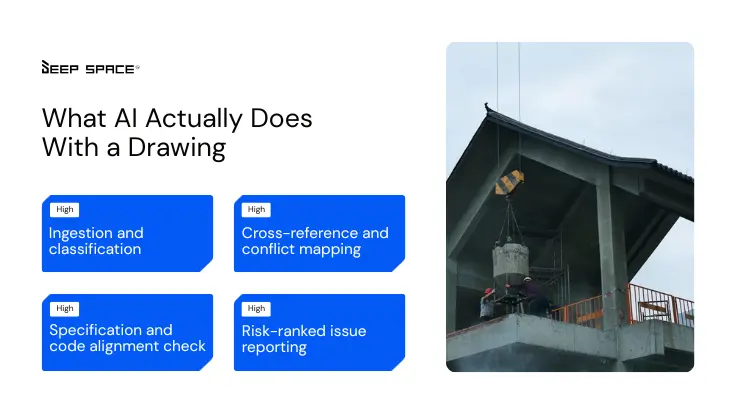
What AI Actually Does With a Drawing
Modern AI construction drawing analysis platforms ingest drawing sets in formats like PDF, DWG, or Revit exports and run multi-layer analysis simultaneously. Here's the core workflow:
01. Ingestion and classification
AI categorises sheets by discipline, including architectural, structural, civil, and MEP, then indexes all callouts, notes, symbols, and dimensions into a searchable model.
02. Cross-reference and conflict mapping
The system compares disciplines against each other. A structural beam that terminates where a duct run is scheduled? Flagged. A door that swings into a column? Caught. This is where drawing risk detection delivers an immediate ROI.
03. Specification and code alignment check
Notes and spec references within drawings are validated against project specifications. Mismatched materials, missing schedules, or undefined assemblies are surfaced automatically.
04. Risk-ranked issue reporting
Issues surfaced in a prioritised list, not a PDF dump. High-risk clashes are separated from minor annotation gaps, so teams know what to resolve before anything else moves.
The Most Common Risks AI Detects Before RFIs
MEP and structural clashes are among the most costly: ductwork, piping, and conduit routed through structural members that are invisible on individual sheets but obvious to cross-referenced AI. Dimensional inconsistencies follow closely, where room dimensions on plan don't reconcile with section or elevation views. Missing detail callouts, specification and drawing mismatches, incomplete door and finish schedules, and outdated code references round out the list. These are the issues that routinely generate field RFIs when missed in preconstruction review.
How AI Construction Drawing Analysis Flags Risks Before Your Next RFI
Every construction project tells the same slow tragedy: drawings get issued, field teams spot a conflict, an RFI gets generated, responses stall, and the schedule bleeds days. The problem isn't that teams lack diligence. It's that manual drawing review at speed is fundamentally unreliable. AI construction drawing analysis revolutionises the process by identifying issues prior to the commencement of construction.
This isn't a vision-of-the-future story. Teams using AI to detect issues in construction drawings before RFIs are already reporting measurable reductions in RFI volume, in some cases by 40% or more in the preconstruction phase alone.
How This Integrates With Construction RFI Software
The real value isn't isolated analysis. It's what happens when drawing risk detection connects directly to your construction RFI software workflow. Platforms like Procore, Autodesk Construction Cloud, and emerging AI-native tools are building this pipeline natively.
When AI detects a potential issue, it doesn't just log it. It can draft a pre-RFI clarification request, assign it to the relevant design discipline, and track resolution before the drawing is issued to the field. This transforms the RFI from a reactive document into a proactive design quality check. Teams using integrated AI workflows report RFI cycle times dropping from an average of 14 days to under 5.
Real Business Impact
A mid-tier commercial builder in Australia piloting AI drawing review across a mixed-use development reduced preconstruction RFI volume by 38% and saved an estimated 220 hours of coordination time before mobilization.
Beyond headline numbers, the downstream effects compound: fewer field surprises, less admin load on project managers and architects, earlier design resolution that protects schedule float, and procurement decisions made on accurate, consistent information.
Risk is also quantified before subcontractors price, which reduces scope gaps in bids and limits claims exposure later. For ANZ builders operating in a market where margins are tight and sovereign project pipelines are accelerating, catching drawing issues upstream is increasingly the difference between a profitable close-out and a dispute-heavy one.
Frequently Asked Questions
1. What file formats does AI construction drawing analysis support?
Most platforms support PDF, DWG, DXF, RVT (Revit), and IFC formats. PDF is the most common for issued-for-construction drawing sets and is well-handled by current AI parsing engines. 3D model formats like IFC unlock additional clash detection depth.
2. Can AI completely replace a human drawing review?
No, and that's not the goal. AI excels at systematic, high-volume cross-referencing that humans do inconsistently at speed. It surfaces issues for human judgment to resolve. The best outcomes come from AI handling the detection layer while experienced project engineers and coordinators own the resolution layer.
3. How does AI drawing risk detection integrate with existing construction RFI software?
Integration varies by platform. Some AI tools have native connectors to Procore, Autodesk, and Aconex. Others export structured issue logs that can be imported. The direction of the industry is toward natively embedded AI review within project management platforms, reducing the need for separate tools.
4. How early in a project should AI drawing analysis be applied?
The earlier the better. AI review is valuable at Design Development to catch coordination gaps before Construction Documents, and again at 50%, 90%, and issued-for-construction milestones. Running analysis at multiple drawing stages catches regressions introduced as drawings evolve.
5. What types of projects benefit most from AI construction drawing analysis?
High-complexity projects with large drawing sets see the greatest ROI: healthcare facilities, data centres, mixed-use residential, and industrial. Mid-size commercial and multifamily projects benefit significantly as well, especially when the design team is geographically distributed and coordination time is compressed.