
From Drawings to Decisions: How AI Is Changing Preconstruction Review for ANZ Builders
Preconstruction is where commercial projects are won or lost. Not on site. Not in the weekly progress meeting. In the weeks before a sod is turned, when someone is sitting with a drawing package trying to understand what is missing, what conflicts, and what is going to become an expensive problem six months from now.
Most mid-tier builders in ANZ are doing this review manually. A senior estimator or project manager works through consultant packages one by one, cross-referencing structural, mechanical, and architectural elements to catch coordination issues and scope gaps before they become RFIs, variations, or delay claims.
It is skilled work. It is also slow, expensive, and heavily dependent on the individual doing it having seen enough projects to know what they are looking for. AI construction drawing analysis software is changing what is possible in this phase. Not by replacing that judgment, but by doing the retrieval, cross-referencing, and gap identification work that precedes it, automatically, before your team has opened a single drawing.
The Problem with Manual Preconstruction Review
A $50M commercial office fitout in Sydney or Melbourne arrives with a drawing package that might include 400 to 800 drawings across architectural, structural, mechanical, electrical, hydraulic, and fire consultant packages. Add LIM reports, geotechnical investigations, seismic assessments, and a project specification running to several hundred pages.
No individual reviewer holds all of that simultaneously. What happens in practice is sequential review: architectural first, then structural, then services. By the time the reviewer gets to services coordination, they are cross-referencing from memory and notes against drawings they looked at two weeks ago.
The issues that get caught are the obvious ones. The issues that get missed are the ones sitting at the intersection of two consultant packages, where the architectural reflected ceiling plan assumes a void height that the structural beam profile does not allow, or where the mechanical specification references a product that is no longer available in the ANZ market.
Those issues do not disappear. They reappear on site, as RFIs that stop work, as variations that cost money, and as delay claims that cost more than the variation itself. The average commercial project in ANZ generates 1 RFI for every $80,000 to $120,000 of contract value. A significant portion of those RFIs originate from coordination issues and scope gaps that existed in the drawing package before construction started. They were just not caught.
What AI Construction Drawing Review Actually Does
1. Drawing Review Before Your Team Starts
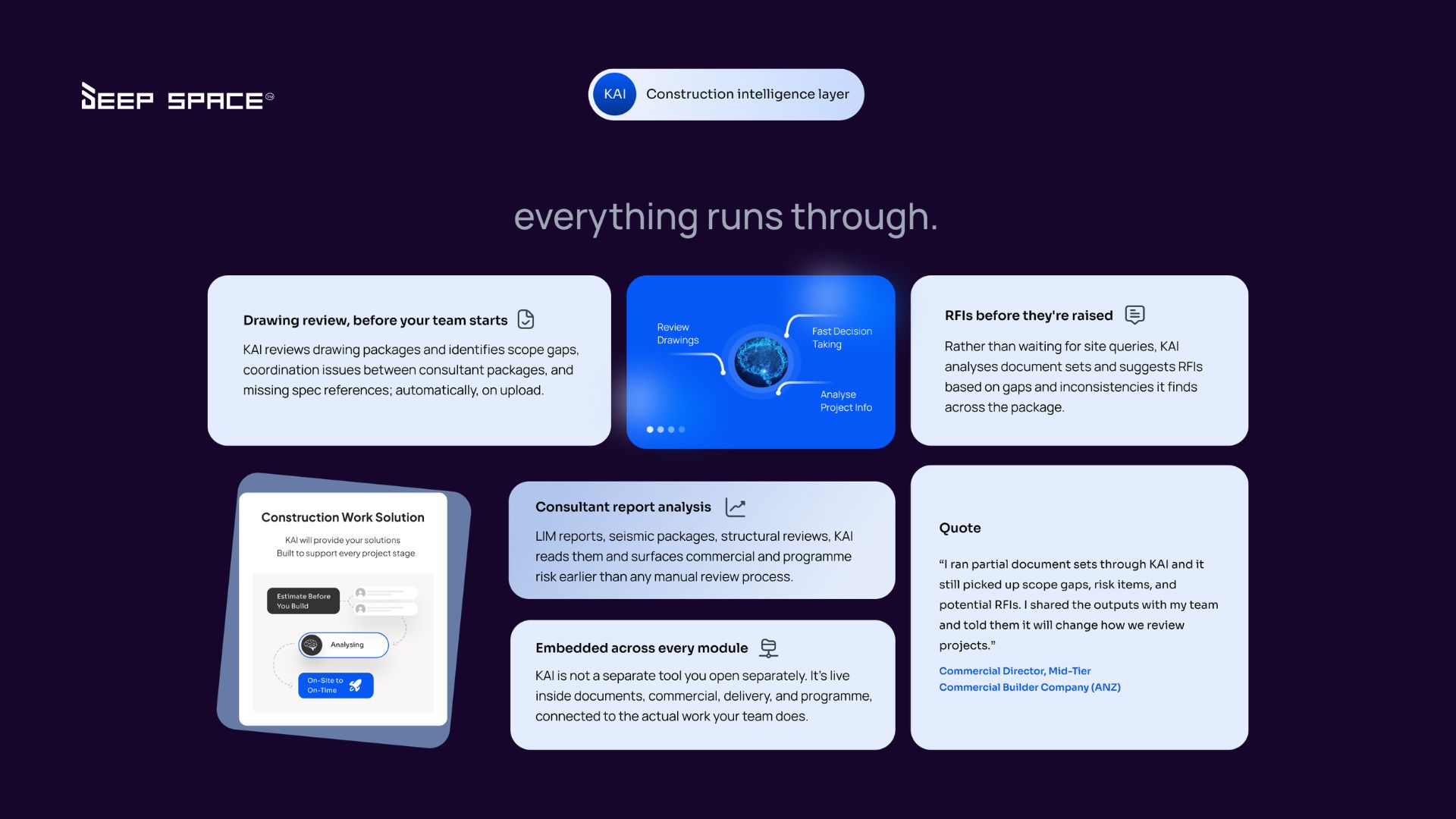
KAI reviews drawing packages on upload. Not after your team has allocated review time and worked through the documents manually. On upload. It identifies three categories of issues: scope gaps, where work appears to be required but no drawing or specification addresses it; coordination issues between consultant packages, where two disciplines conflict or make incompatible assumptions; and missing specification references, where a drawing calls out a spec clause that does not exist or references a superseded document.
This happens across the entire package simultaneously. KAI is not reading architectural drawings in isolation and then structural drawings in isolation. It is reading them together, the same way a highly experienced project engineer would, but without the time constraints that mean a human reviewer has to prioritise where to focus.
What this changes for a preconstruction team: the first human review of a drawing package is no longer a search for problems. It is a review of problems already identified, with the reviewer applying judgment to assess commercial and programme significance. That is a fundamentally different and more productive use of senior time.
2. RFIs Before They Are Raised
The standard workflow is: drawings are issued, construction starts, the subcontractor hits a problem on site, an RFI is raised, the consultant responds, work either stops or proceeds at risk.
KAI reverses the sequence. It analyses document sets and suggests RFIs based on the gaps and inconsistencies it finds before construction starts. The RFI list is generated during preconstruction, not during delivery.
This matters for two reasons. First, an RFI answered during preconstruction costs almost nothing. The consultant is still engaged, the design is still open, and the builder has leverage. An RFI answered during construction, when a subcontractor crew is standing by, costs multiples of that.
Second, a pre-generated RFI list changes the dynamic with consultants at the start of a project. Instead of a reactive back-and-forth that runs throughout the project, you are presenting a structured list of specific gaps and coordination issues at the outset. It is a different conversation, and it produces faster, more substantive responses.
3. Consultant Report Analysis
LIM reports, geotechnical investigations, seismic packages, and structural peer reviews: these documents carry significant commercial and programme risk, and they are almost always reviewed by one person under time pressure.
KAI reads these documents and highlights the risks that matter to a builder, not a consultant. Geotechnical reports make assumptions about founding conditions, which can lead to significant cost exposure if they differ from the actual conditions encountered. Seismic packages contain structural requirements that affect the program's sequence and subcontractor's scope. LIM reports contain encumbrances and easements that affect site access, crane placement, and temporary works planning.
A senior PM reading a geotechnical report knows what to look for. A project coordinator doing the first pass often skips this step. KAI highlights the commercially significant findings, irrespective of the document's opener, and does so prior to making programme commitments.
4. Embedded Across Every Module
This functionality is the part that separates KAI from the category of AI tools that add a feature and call it intelligence. KAI is not a separate drawing review tool you open alongside Deep Space. It is live inside documents, delivery, and programmes. When KAI identifies a coordination issue in a structural drawing that affects a subcontractor package, that finding is connected to the relevant subcontractor scope in the commercial module. When it surfaces a risk in a consultant report that affects the programme sequence, that sits alongside the delivery timeline, not in a separate AI dashboard that someone has to remember to check.
The practical difference: insights from the preconstruction review remain accessible throughout the review and construction stages. They are in the system where the project team is already working, accessible when the decision they affect is being made, not only when someone thinks to look for them.
Where This Changes the Numbers
The financial case for AI preconstruction review is not abstract. Variation costs on ANZ commercial projects average 8 to 12% of contract value. Industry research consistently attributes 30 to 40% of that variation cost to issues that were present in the original drawing package and not identified during preconstruction review.
On a $40M project, the variation exposure ranges from $960,000 to $1.92M and traces back to the preconstruction phase. Beyond the variation cost, the program's impact is significant. An RFI raised during construction that requires consultant redesign and reissue of drawings takes an average of 14 to 21 days to resolve. That resolution time is not always on the critical path, but it often is on a programme with limited float.
The builders who are using AI construction drawing analysis to catch coordination issues and scope gaps before construction starts are not just saving money on individual variations. They are building a systematic preconstruction process that compounds across projects, because the issues being caught are consistent across building types, and the institutional knowledge embedded in the review process improves with each project dataset.
What This Means for ANZ Builders Specifically
The ANZ commercial construction market has specific characteristics that make preconstruction review both more important and harder to do well than in comparable markets.
Consultant documentation standards vary significantly across jurisdictions. A drawing package produced for a project in Queensland carries different assumptions about what is coordinated by the architect versus the builder's responsibility than an equivalent package in Victoria. A building in Wellington has seismic requirements that affect structural, mechanical, and facade consultant coordination in ways that are not always explicitly called out in individual packages.
Manual review catches what the reviewer knows to look for, based on the jurisdictions they have worked in. AI construction drawing analysis applies consistent review criteria across the entire package, regardless of jurisdiction-specific quirks, because it is reading the documents rather than relying on reviewer memory.
For mid-tier builders operating across multiple states or across ANZ, this consistency has real value. The preconstruction review quality on a project in Perth does not depend on whether the PM assigned to that project has worked extensively in Western Australia. It depends on whether the drawing package has been reviewed systematically.
The Shift That Is Already Happening
Preconstruction has historically been the phase where mid-tier builders invest the least in processes and technology, because the pressure and the spend are concentrated in delivery. The logic made sense when the alternative was enterprise software with implementation timelines that outlasted the preconstruction phase itself.
AI preconstruction review software that activates upon upload and surfaces findings within the project team's existing workflow is a distinct category of tool. It does not require a dedicated preconstruction technology strategy. It requires uploading a drawing package.
The builders who are ahead on this task are not the ones with the largest technology budgets. They are the ones who recognised that the variation and programme risk in their drawing packages were always present, and that the only change is that they now have a tool to identify it before construction starts.
KAI reviews your drawing package on upload, surfaces coordination issues and scope gaps before your team starts, and sits inside the Deep Space modules where your team is already working. See how it works on a live project.
FAQS
1. What is AI construction drawing analysis, and how does it help ANZ builders?
AI construction drawing analysis automatically checks architectural, structural, and MEP drawings to find problems with coordination, missing details, and errors. For ANZ builders, this reduces RFIs, prevents costly variations, and improves preconstruction accuracy.
2. How does AI preconstruction review reduce RFIs in Australia?
AI identifies design gaps and conflicts before construction begins. This allows builders to raise RFIs early during preconstruction instead of during project execution, saving time, cost, and delays.
3. Is AI construction drawing review suitable for mid-sized builders in Australia and New Zealand?
Yes. AI tools are especially valuable for mid-tier builders in ANZ who handle large drawing packages but lack large preconstruction teams. AI helps standardise review quality across projects and locations.
4. What problems does construction drawing analysis software solve?
It solves issues like scope gaps, consultant coordination conflicts, missing specifications, and outdated references. These are common causes of RFIs, delays, and cost overruns in commercial construction projects.
5. How can builders in ANZ implement AI preconstruction review?
Builders can implement AI tools by uploading drawing packages to platforms that automatically analyse documents, generate RFIs, and identify risks. No complex setup is required, making adoption faster for construction teams.