
Procore Pricing in Australia: What Mid-Tier Builders Actually Pay (And What They Don't Get)
If you've looked at Procore pricing in Australia recently, you'll know two things. First, they don't publish it. Second, when you get the number, it's bigger than you expected. This isn't a Procore hit piece. It's a straightforward look at what mid-tier commercial builders in Australia and New Zealand actually pay when they go down the Procore path, what they get for that investment, and where the model starts to break down for builders who aren't running a $500M programme with a dedicated IT function.
How Procore's Pricing Model Actually Works
Procore prices on annual construction volume, not on users or projects. That means the more revenue your business does, the more you pay, regardless of how many projects you're actually running through the platform or how efficiently your team uses it.
For mid-tier commercial builders in Australia; the companies running $10M to $100M in annual project value, this model has a fundamental problem. Your revenue can grow without your margin growing. If you have a strong year by volume, your Procore bill goes up. If that volume came from a thin-margin project, the software cost compounds an already tight commercial position.
This is not how any other operational tool in your business is priced. Your accounting software, your scheduling tool, your HSEQ system; none of them charge more when you win more work. Procore's revenue-based pricing model is a structural mismatch for how mid-tier builders actually run.
The Stack Problem Nobody Talks About
The published Procore cost for builders in Australia is only part of the picture. What most builders discover once they're in is that Procore doesn't replace your stack, it becomes the centre of it.
A typical Procore-based setup at a mid-tier ANZ builder looks something like this: Procore for documents, RFIs, and basic delivery. A financial system like JobPac or CHEOPS for cost management. A separate HSEQ platform like HammerTech or Donesafe for safety. Middleware or a paid connector to make Xero work. Sometimes a separate procurement tool. Sometimes a CRM sits outside everything.
Every one of those is a separate subscription. Every connection between them is a point of failure. Builders who have run this stack will tell you about the invoice that didn't sync, the claim that went out with the wrong value because the Xero connector failed silently, the variation that lived in one system but not the other.
The hidden cost of Procore in Australia isn't just the licence fee. It's the overhead of running and maintaining a four to six-tool stack, plus the hours your commercial team spends reconciling data across systems that don't talk to each other cleanly.
What the Implementation Actually Costs
Procore implementation cost in Australia is another number that doesn't get discussed upfront. Eighteen months is a realistic timeline for a mid-tier builder going through a full Procore rollout. That includes configuration, training, parallel running, and the point where your team has actually stopped working around the system and started working inside it.
One commercial director at a NSW builder described it clearly: they went through the full Procore process, spent significant budget on implementation and licence fees, and at the end of it their team was still running key workflows out of spreadsheets. The product had been configured but the adoption hadn't followed.
This isn't unique to Procore. Any enterprise construction platform carries implementation risk. But it matters for mid-tier builders specifically because you don't have a dedicated software administration team to absorb that rollout. Your PMs and QSs are on live projects. They can't afford six months of parallel running while a new system beds in.
What Procore Was Actually Built For
Understanding Procore pricing Australia requires understanding who Procore was built for. The product was designed for large US general contractors running significant project volumes with deep IT and operations functions. The language in the platform reflects this; change orders instead of variations, US tax conventions, American document workflows.
For builders in Australia and New Zealand, this creates a translation problem that goes beyond terminology. CCA-compliant progress claims, GST, AS/NZS standards, local data residency requirements, these aren't native to Procore. Some are handled through add-ons. Some require workarounds. Some just require your team to adapt how they work to fit the system rather than the other way around.
This matters operationally. When your PM is raising a variation and the system uses the wrong terminology, when your claims workflow doesn't reflect how CCA works in your state, when your Xero sync requires middleware that sometimes fails; the friction accumulates across every project, every week.
Where Procore Is Still the Right Answer
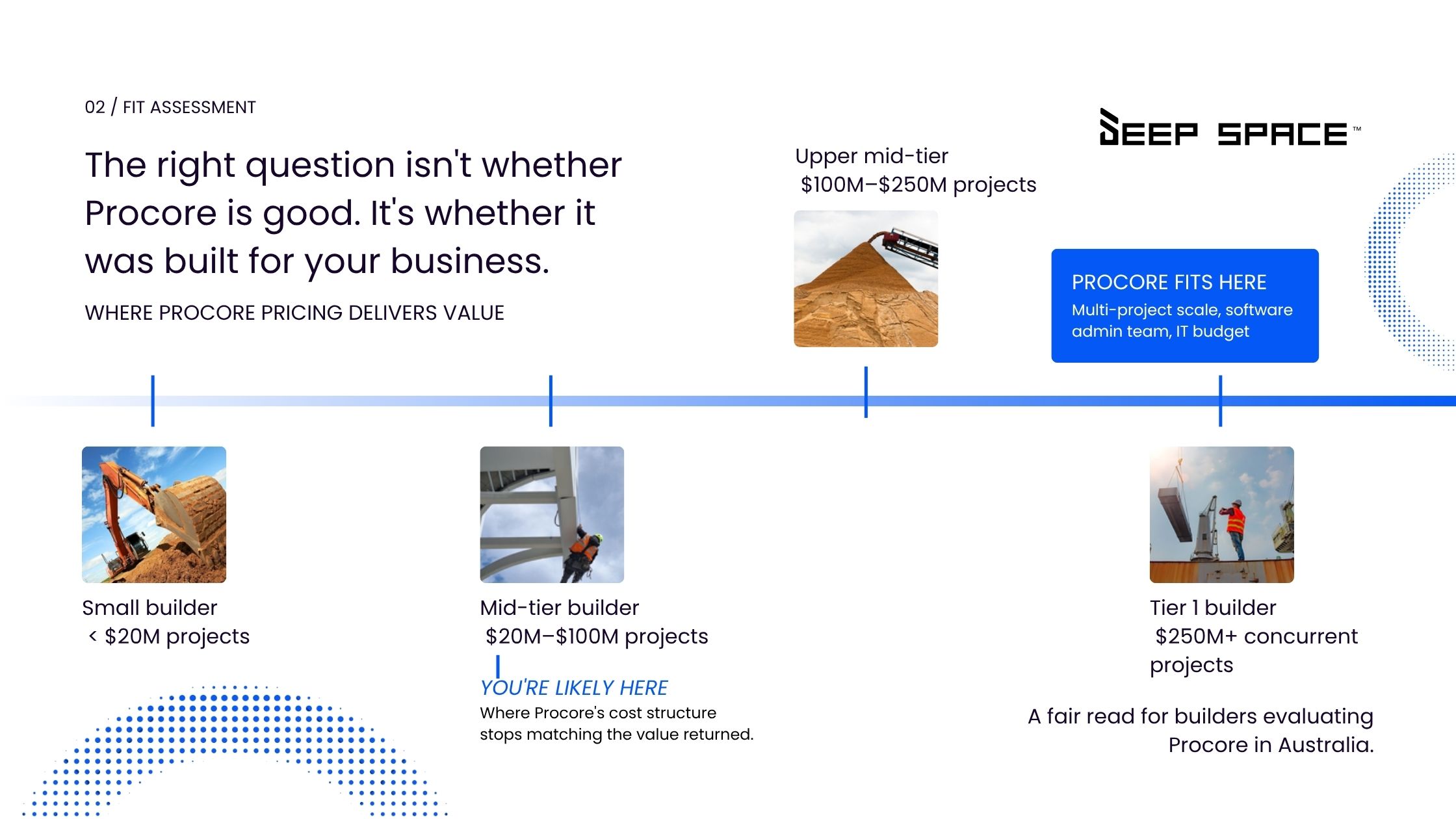
To be fair about it: Procore is the right choice for some builders. If your business is at genuine Tier 1 scale, running multiple concurrent major projects with a software administration team and a technology budget to match, Procore's depth and marketplace breadth makes sense. If you're heavily invested in the Procore ecosystem and your team has been using it for years, switching carries its own cost and risk.
The question for mid-tier builders isn't whether Procore is a good product. It is. The question is whether it was built for your business size, your market, and your commercial model, and whether the cost structure reflects the value you're actually getting from it.
What Flat-Fee Construction Software Pricing Looks Like
The alternative to revenue-based pricing is a flat annual fee regardless of project volume. For mid-tier builders, this changes the commercial logic of the software decision entirely. You're not penalised for growth. A strong revenue year doesn't trigger a pricing conversation with your software vendor. Your software cost is predictable and doesn't move when your programme does.
Flat fee construction management software in Australia is also easier to evaluate on ROI. If the cost is fixed, the question is simply whether the platform saves enough time, reduces enough risk, and replaces enough of your existing stack to justify the number. That's a cleaner calculation than trying to model what a revenue-based subscription costs you at different turnover scenarios.
The Real Question for Mid-Tier Builders
If you're evaluating construction management software pricing in Australia right now, the Procore question is worth asking clearly. Not just what does the licence cost, but what does the full stack cost? What does implementation realistically cost in time and internal resources? What does it cost to maintain a set of tools that don't talk to each other natively?
Mid-tier commercial builders in Australia have spent years caught between tools that are too basic and platforms that were built for someone else. The honest answer to the Procore pricing question isn't just a number. It's whether the product was designed for the way your business actually runs.
Deep Space is a flat-fee construction management platform built for mid-tier commercial builders in Australia and New Zealand; with native Xero, CCA-compliant claims, and AI built across every workflow. If you're evaluating Procore or looking to come off it, see how Deep Space maps to your current stack.
Frequently Asked Questions
How much does Procore cost for builders in Australia?
Procore doesn't publish pricing publicly. Their model is based on annual construction volume, so the licence fee scales with your revenue. For mid-tier builders running $10M to $100M in project value, the total cost including the stack of additional tools required alongside Procore is significantly higher than the base licence figure.
Why doesn't Procore publish its pricing in Australia?
Because the price is calculated against your annual construction volume and negotiated per business. Two builders running similar projects can be on very different rates depending on when they signed, how the deal was structured, and what modules were included.
What is included in Procore's base licence for Australian builders?
The base licence covers core modules like project management, documents, and RFIs. Financial management, quality, safety, and analytics modules are typically separate. Most mid-tier builders end up paying for additional modules and third-party tools to cover functions that aren't native to Procore for the ANZ market.
What are the alternatives to Procore for mid-tier builders in Australia?
The main alternatives depend on what you're trying to solve. For builders who want a single connected platform across commercial, programme, delivery, HSEQ, and procurement without a stack of integrations, purpose-built ANZ platforms like Deep Space are worth evaluating alongside Procore.
How long does a Procore implementation take for a commercial builder in Australia?
A realistic full implementation for a mid-tier builder runs anywhere from six to eighteen months, depending on the complexity of your workflows and how many systems you're migrating from. Builders who have been through it consistently flag that adoption takes longer than configuration.